
White County Sex Offender Checks
The Illinois State Police Sex Offender Registry is the main public channel for a White County sex offender lookup. ISP updates the statewide database each day. It covers people included under Illinois sex-offender and certain crimes-against-children laws. It is not a complete criminal record, and it does not tell a reader whether a person will commit a future offense.
Start with the state search and narrow it to White County. If a profile needs confirmation, contact the law-enforcement office shown as the registering agency. White County residents who register with the county work through the White County Sheriff. A person who lives within a municipality may instead report to that city's police department. Court papers for the qualifying case belong to the circuit clerk in the county of conviction, while an incident report stays with the agency that wrote it.
White County Registry Verification
The White County Sheriff is the local registration and verification contact for residents assigned to the county agency. Its office is at 108 N. Main Cross Street in Carmi, and the main number is 618-382-5321. Call first to confirm appointment times and which documents to bring. The sheriff's public site does not post a separate registry-office schedule.
ISP directs requests for a copy of an offender registration form to the law-enforcement agency where the person registered. That form is distinct from the public profile. It is also distinct from the court file and the police report. Keeping those custodians straight prevents a common White County search error: asking one office for a document created and maintained by another.
White County Sheriff
108 N. Main Cross St.
Carmi, IL 62821
618-382-5321
Call before visiting for registry hours and required documents.
Illinois State Police Registry Searches
Open the ISP registry search and read the terms before continuing. The form supports broad name searches and detailed location or status filters. A good White County search begins with the least data needed to find a useful result, then adds fields to separate people with similar names.
- Read and accept the ISP conditions of use.
- Enter a first and last name, or select White in the county field.
- Narrow the results with a birth date, city, ZIP code, status, homeless flag, or offender type.
- Open the Details link and compare the profile identifiers with reliable facts.
| Field | Type | Required | Use |
|---|---|---|---|
| First and Last Name | Text | No | Begin with the name, then narrow. |
| Date of Birth | Date/text | No | Use an exact date when known. |
| City or ZIP Code | Text | No | Filter places such as Carmi, Grayville, or Norris City. |
| County | Dropdown | No | Select White; the list also covers incarcerated and out-of-state groups. |
| Status or Type | Dropdown | No | Narrow by registry category or compliance status. |
| Homeless | Checkbox | No | Filter by homeless registration status. |
| Map Your Neighborhood | Map link | No | Search from an address or clicked map point. |
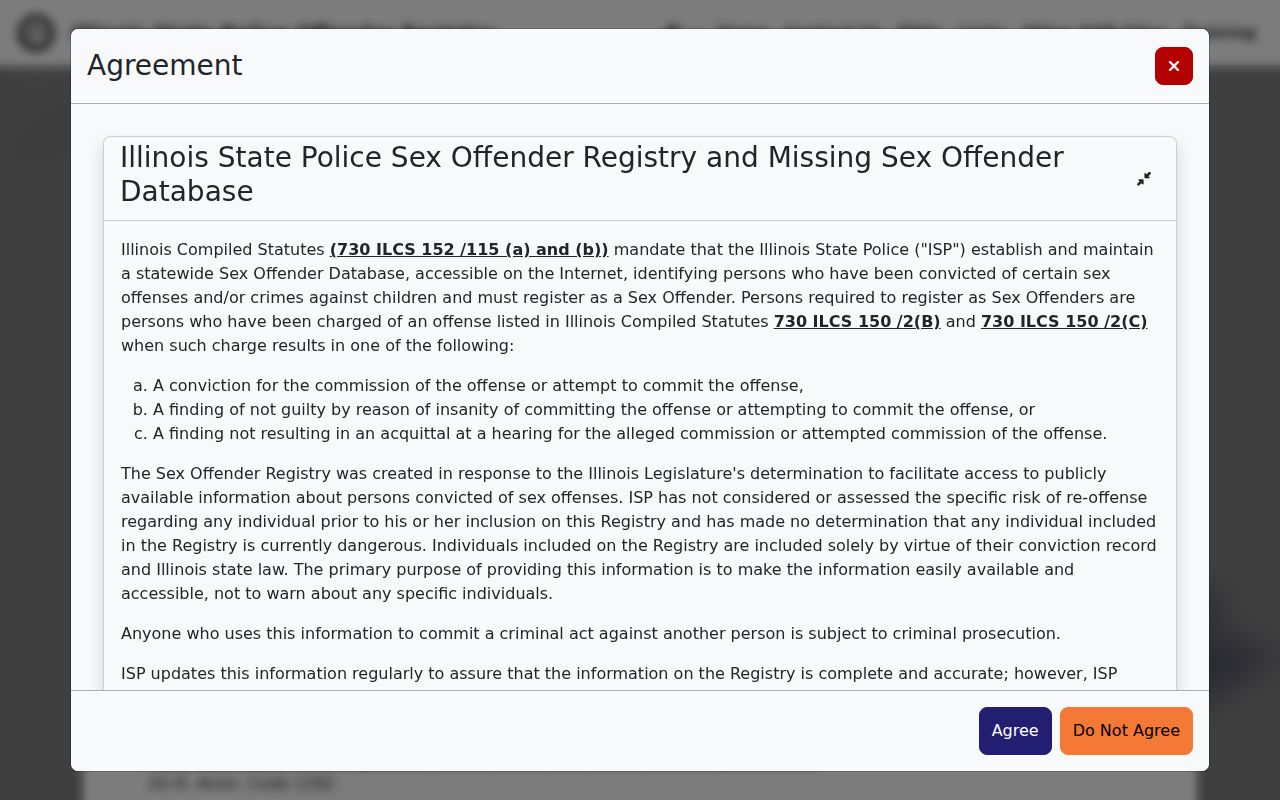
The official ISP registry disclaimer and gateway can be seen in this source view.
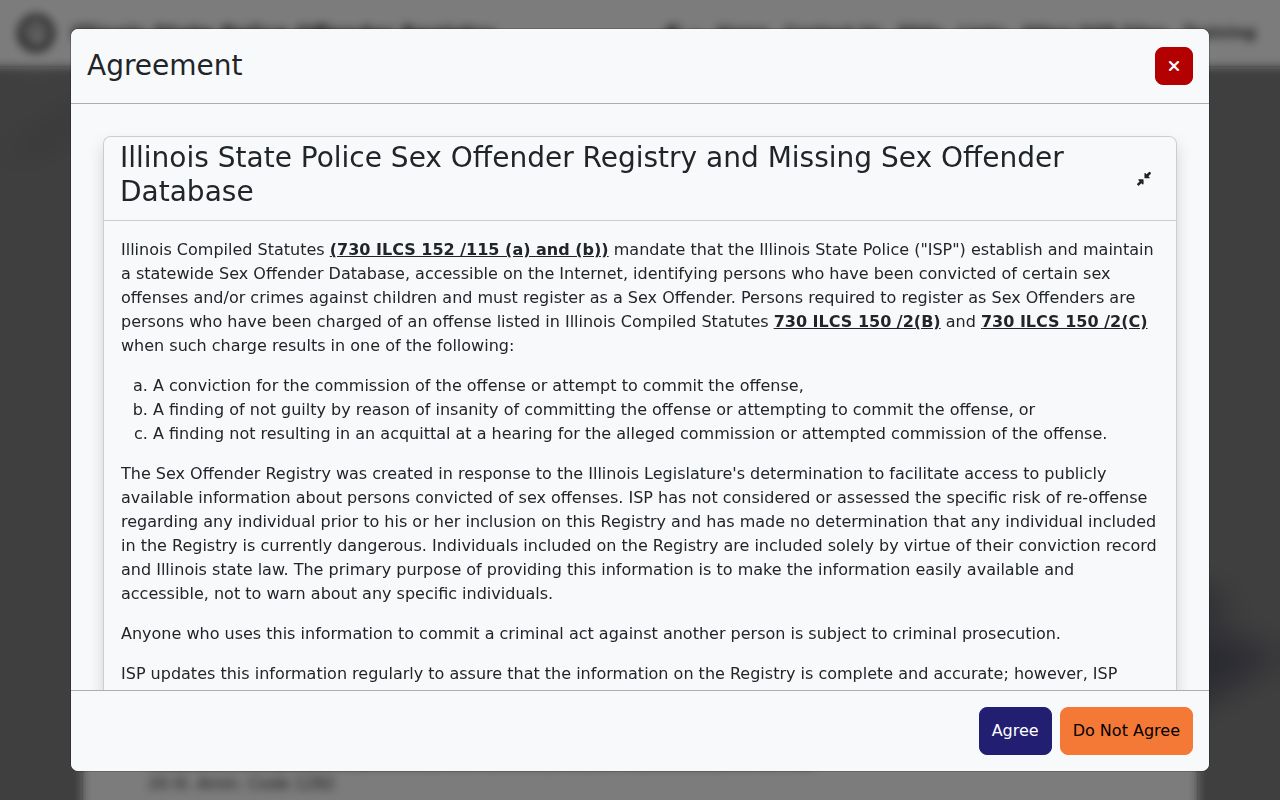
The agreement screen matters because it states the database's limits before a White County result is shown.
White County Neighborhood Map
The ISP Map Your Neighborhood tool accepts an address or a point selected on the map. Yellow markers can be opened to show detail in a side pane. Use the map as a geographic view of registry entries, not as a risk score. The accessible official text did not state fixed radius choices, so users should rely on the controls shown in the live map rather than assume a set distance.
A marker is tied to registry data supplied through the statutory process. It does not prove current conduct, predict future conduct, or replace a close read of the profile. If the address or status appears wrong, note the registering agency and ask that office to verify its record. Do not confront the listed person or household.
Registry Profiles: What They Show
Each result row offers a Details link. The full view combines identity, location, status, and qualifying-offense information when those fields are public and populated. Compare more than a name. A current photo, birth date, physical description, and registering agency can help distinguish one person from another.
| Name and Aliases | Current identity plus other published names. |
|---|---|
| Photo and Description | Photo, age or birth date, sex, race, height, weight, hair, eyes, and listed marks. |
| Registered Location | Residence or location, registering agency, and homeless, incarcerated, or out-of-state notation when applicable. |
| Offense Information | Qualifying offense, statute, conviction or adjudication place, and date when populated. |
| Category and Status | Offender type, compliance state, and update or verification context. |
| Other Public Data | Vehicle, school, or other statutory registration fields when published. |
The live profile structure appears through the official ISP search.
This layout helps separate the registry category from the case details held by a court.
White County Registry Record Sources
A registry entry is only one record layer. Ask the registering sheriff or police department for the registration form and for help with a possible address or compliance error. Ask the White County Circuit Clerk for a White County conviction file. Request the incident report from the police or sheriff's agency that created it.
That division also explains why the registry should not be read as a full rap sheet. ISP's public registry focuses on statutory registration data. Illinois conviction information follows a different route through the Bureau of Identification, and a court docket may show motions or later orders that do not appear in the registry profile. For broader local record context, use the White County criminal history overview.
Note: A daily registry update can still depend on timely and accurate data from the registering local agency.
Registration Levels and Duties in Illinois
Illinois should not be reduced to a public Tier I, II, and III chart. Duration and visibility depend on statutory classifications. Many people classified as sex offenders register for ten years from the statutory starting point, subject to tolling or extensions. Sexual predators and several other serious or repeat categories have lifetime duties. Juvenile and other special categories need their own statutory analysis.
| Illinois Category | General Duration | Visibility and Verification |
|---|---|---|
| Sex offender outside a lifetime category | Commonly 10 years, subject to statutory start, tolling, and extensions | Public status and verification duties depend on the governing classification. |
| Sexual predator | Lifetime | Lifetime registration with verification set by Illinois law. |
| Sexually dangerous or violent person and specified serious or repeat categories | Lifetime or special treatment | Apply the category-specific rules. |
| Juvenile or adjudicated categories | Special rules | Do not apply the adult table mechanically. |
Sections 3 and 7 of the Illinois Sex Offender Registration Act control person-specific registration duties. The category on the actual profile and the current statute should be checked before stating a duration or verification schedule.
White County and NSOPW
The ISP database is the direct source for an Illinois and White County lookup. When an address history or personal safety search crosses a state line, the U.S. Department of Justice National Sex Offender Public Website provides a national gateway to participating jurisdictions. It is a second search layer, not a replacement for checking the state profile and its registering-agency contact.
The national gateway is shown in this official source image.
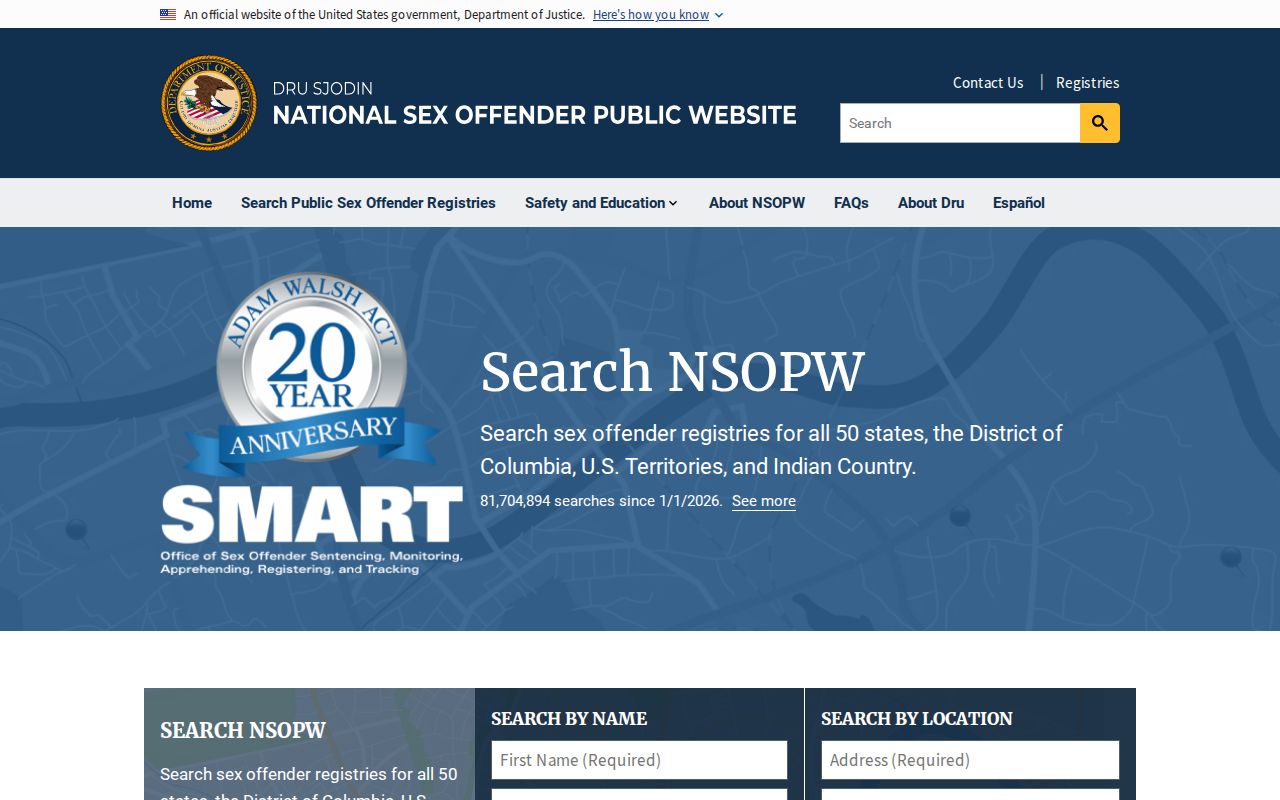
Use an NSOPW result to identify the source jurisdiction, then verify the full entry with that jurisdiction's official registry.
Correcting White County Registry Details
If a White County profile appears inaccurate, record the profile details and the registering agency named on it. Contact that sheriff or police department and describe the field in question. ISP specifically directs accuracy and compliance questions to the local registering agency. Court-document questions go to the circuit clerk or prosecutor in the conviction county.
Suspected noncompliance should also go to the registering agency or local law enforcement. Use 911 only for an emergency. This route gives trained staff the facts and avoids confrontation. It also respects the difference between a lag in a daily-updated database, an address-verification issue, and an actual violation that law enforcement must assess.
Using Registry Information Lawfully
The Illinois registry exists for public awareness and safety planning. Readers may use it to understand nearby entries, verify an official profile, and make calm personal or family safety choices. The Sex Offender Community Notification Law requires the ISP Internet database and sets the public-notification framework.
ISP warns that the information may not be used to harass or threaten a registrant or the person's family. The presence of a White County registry profile does not establish that the listed person will commit a future crime. Share concerns with the proper local agency. Do not publish threats, organize confrontation, or treat a map marker as a forecast.
Lawful use required: Harassment, stalking, intimidation, or threats based on registry information may violate Illinois criminal law; report safety concerns to law enforcement.